Beyond Workflow Automation: Higher-Order Agentic Systems for Wealth Management
Discover how higher-order agentic systems combine contextual memory, scenario simulation, and adaptive reasoning to help wealth managers interpret market shifts, compare possible futures, and inform investment decisions.


Reasoning Across Complexity, Uncertainty, and Evolving Environments
The current wave of Agentic AI has already demonstrated something important: AI systems are no longer limited to isolated predictions or single-function execution.
By combining large language models with memory, tools, planning loops, and APIs, modern agentic systems can now complete end-to-end workflows autonomously. They can book hotels, manage CRMs, coordinate tasks, write code, generate reports, and operate conversational support systems with remarkable efficiency. Recent research on agentic architectures describes this transition as the evolution from isolated inference systems toward autonomous tool-using intelligence capable of multi-step planning and execution [1].
This is a meaningful leap from the earlier generation of AI.
However, most of today’s agentic systems — including many built on top of frontier models like Claude, GPT, and Gemini — still fundamentally operate as First-Order Agentic Systems.
These systems are exceptionally effective at workflow orchestration. They can coordinate tools, retrieve information, execute predefined actions, and autonomously complete operational tasks across structured environments. Industry research in financial services increasingly characterizes current enterprise agents as systems optimized for bounded workflows, procedural execution, and operational automation rather than adaptive reasoning under uncertainty [2].
In essence, most first-order agentic systems are optimized for:
- Task completion
- Workflow execution
- API orchestration
- Conversational assistance
- Deterministic operational flows
They automate processes efficiently. But they do not deeply reason about evolving systems.
The Limitation of First-Order Agentic Systems
This distinction becomes critically important when we move into environments where the rules themselves are unstable.
In structured domains — customer support, scheduling, CRM workflows, and booking systems — the environment is largely predictable. There are clear actions, clear states, and measurable outcomes. The agent’s role is primarily orchestration.
But many real-world systems do not behave this way.
Financial markets, macroeconomic systems, geopolitical landscapes, supply chains, and strategic decision environments are inherently non-stationary. The underlying causal structures continuously evolve. Correlations collapse. New lead indicators emerge unexpectedly. Historical patterns stop working.
These environments are not workflow problems. They are reasoning problems.
Emerging AI research increasingly distinguishes between procedural automation systems and adaptive reasoning systems capable of operating under evolving and non-stationary environments [1]. This is where the limitations of first-order agentic architectures begin to surface.
A first-order agent can execute a sequence of actions.
A higher-order agentic system must:
- Interpret context
- Reason across changing regimes
- Simulate possible futures
- Evaluate competing hypotheses
- Organize fragmented information
- Continuously adapt its internal understanding of the environment
This represents an entirely different order of intelligence.
The Emergence of Higher-Order Agentic Systems
We are now entering the next phase of AI evolution: the emergence of Higher-Order Agentic Systems.
These systems move beyond workflow execution into adaptive analytical reasoning. Instead of simply automating operational flows, higher-order agentic systems attempt to model the environment itself. They operate less like assistants and more like evolving cognitive systems capable of contextual interpretation under uncertainty.
The distinction is profound.
First-order agentic systems ask: “What action should I execute next?”
Higher-order agentic systems ask: “What is changing in the environment, why is it changing, and how should reasoning itself adapt?”
This transition becomes especially important in financial markets.
Markets are not governed by static rules. They are adaptive systems shaped by liquidity cycles, geopolitical shifts, policy changes, behavioral feedback loops, technological disruption, and continuously emerging lead indicators. Recent literature on AI-native financial systems argues that future financial intelligence architectures must reason across uncertainty, systemic interactions, and changing market regimes rather than rely solely on historical pattern recognition [3][4].
The combinatorial landscape becomes exponential.
Historical market data alone is insufficient because markets constantly move out of distribution. Patterns that hold in one regime often become irrelevant in another. The challenge is no longer merely prediction — it is contextual reasoning under evolving uncertainty.
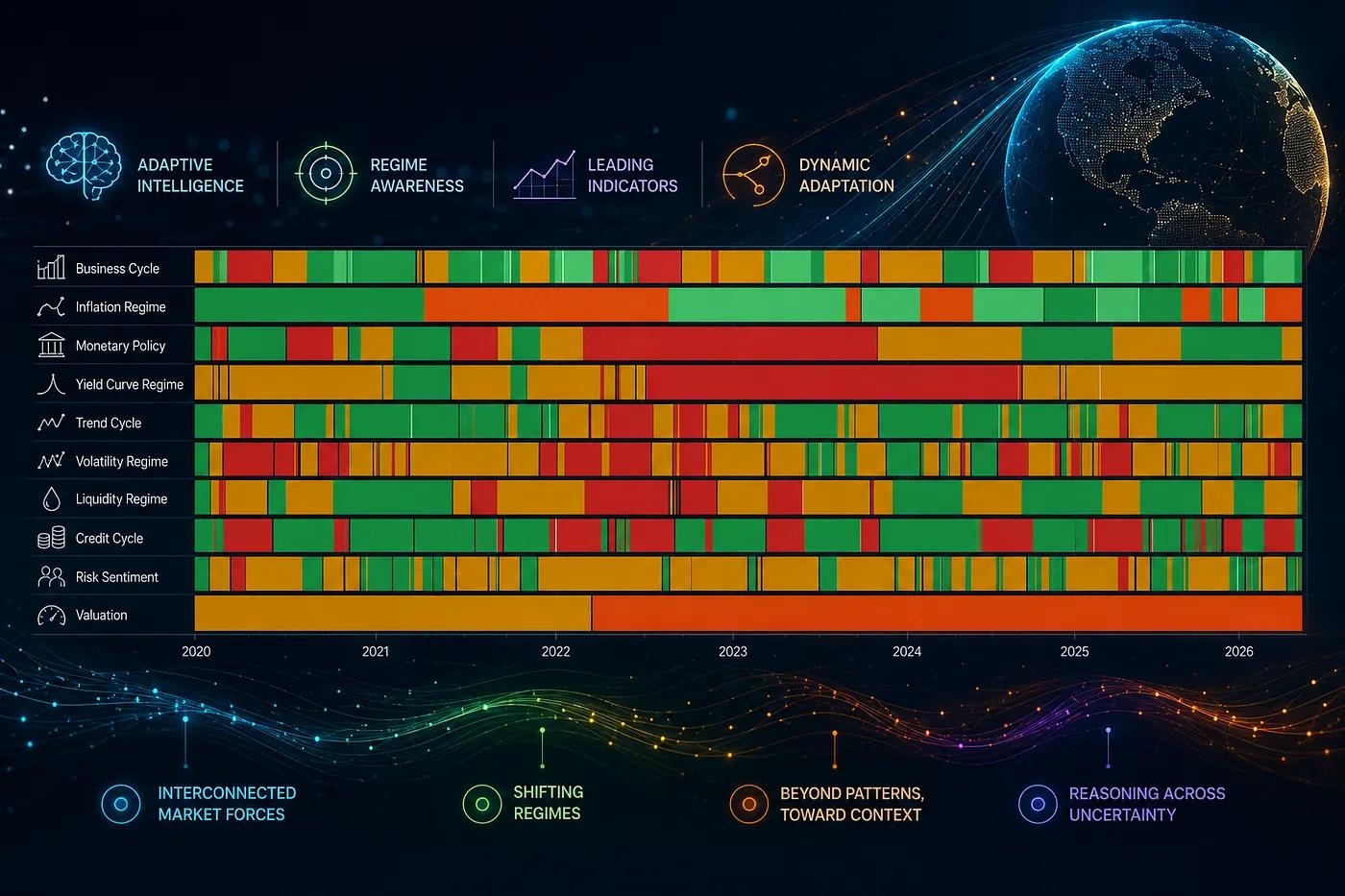
Financial markets rarely operate within a single stable regime. Inflation dynamics, liquidity conditions, monetary policy, volatility, credit cycles, and investor sentiment continuously interact and evolve simultaneously. The broader state map below illustrates how these overlapping regimes shift over time — and how leading indicators often begin changing well before consensus recognizes a structural transition.
Press enter or click to view image in full sizeImage: State Map of Evolving Market Regimes (2020–2026)
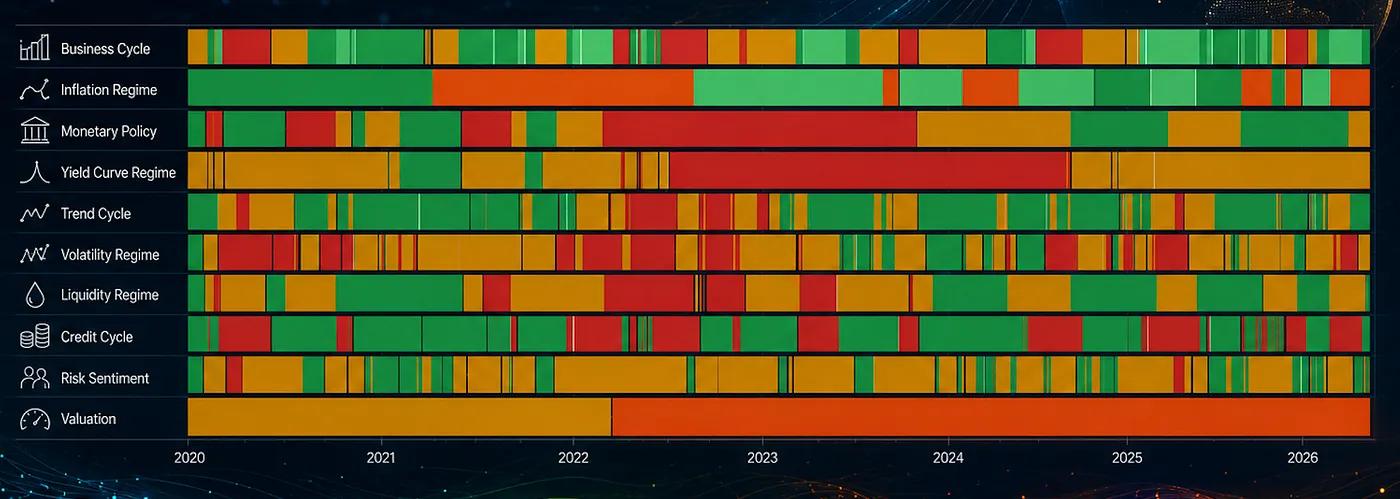
This is precisely why higher-order agentic systems are necessary. Markets are not driven by isolated signals, but by interconnected systems whose relationships continuously evolve across regimes.
The ability to interpret these shifting dynamics — and adapt reasoning as new leading indicators emerge — is what separates workflow automation from adaptive financial intelligence.
This requires systems capable of:
- Market regime interpretation
- Scenario modeling
- Probabilistic future simulation
- Historical contextualization
- Adaptive hypothesis generation
- Dynamic reasoning across fragmented information
Research into reflective agentic architectures for financial systems increasingly explores how structured reasoning loops, simulation frameworks, and adaptive feedback mechanisms can improve robustness in non-stationary market environments [5].
In many ways, this represents the transition from workflow intelligence to adaptive cognitive intelligence systems.
How HyperNorm AI Is Approaching This Shift
This is precisely the frontier HyperNorm AI is focused on.
At HyperNorm AI, the belief is that the future of financial intelligence cannot be built through isolated models or first-order agents alone. The next generation of AI systems must operate as higher-order reasoning architectures capable of continuously interpreting evolving market structure.
This direction builds upon HyperNorm AI’s earlier work on generalized financial intelligence, neuro-symbolic systems, causal reasoning, and the orchestration of inductive and deductive reasoning systems in finance [8][9][10][11].
The goal is not to build another automation layer on top of LLMs.
It is to build analytical intelligence systems capable of:
- Reasoning across market regimes
- Organizing fragmented financial information
- Simulating alternative futures
- Interpreting macroeconomic context
- Understanding causal structures across markets
- Adapting dynamically as new lead indicators emerge
By combining agentic architectures, structured financial reasoning, contextual memory systems, scenario simulation, neuro-symbolic frameworks, and continuously evolving intelligence architectures, HyperNorm AI is building toward AI-native asset intelligence designed for environments that are perpetually out of distribution.
The next wave of AI will not simply be defined by larger models or better workflow automation. It will be defined by systems capable of reasoning through complexity when the environment itself becomes unstable [6][7].
References
- A. C. Author et al., “Agentic Architectures and Autonomous Tool-Using Intelligence,” Artificial Intelligence Review, 2025. https://link.springer.com/article/10.1007/s10462-025-11422-4
- CFA Institute Research & Policy Center, “Agentic AI for Finance,” The Automation Ahead Content Series, 2025. https://rpc.cfainstitute.org/research/the-automation-ahead-content-series/agentic-ai-for-finance
- “AI-Native Financial Intelligence Systems Under Uncertainty,” arXiv preprint, 2026. https://arxiv.org/abs/2603.13942
- “Adaptive Reasoning Architectures for Financial Markets,” arXiv preprint, 2026. https://arxiv.org/abs/2604.21672
- “Reflective Agentic Architectures for Financial Systems,” Proceedings of the ACM, 2025. https://dl.acm.org/doi/full/10.1145/3768292.3771251
- S&P Global, “Agentic AI: Scaling Fragmented Financial Markets,” Future of Capital Markets Report, 2025. https://www.spglobal.com/en/research-insights/special-reports/look-forward/future-of-capital-markets/agentic-ai-scaling-fragmented-financial-markets
- Cambridge Judge Business School, “From Automation to Autonomy: The Agentic AI Era of Financial Services,” 2025. https://www.jbs.cam.ac.uk/2025/from-automation-to-autonomy-the-agentic-ai-era-of-financial-services/
- HyperNorm AI, “The Emergence of Generalized Financial Intelligence,” Medium, 2025. https://medium.com/@hypernorm.ai/the-emergence-of-generalized-financial-intelligence-8e36aa8a7d4d
- HyperNorm AI, “Reasoning with Markets: Orchestrating Inductive and Deductive Reasoning,” Medium, 2025. https://medium.com/@hypernorm.ai/reasoning-with-markets-orchestrating-inductive-and-deductive-reasoning-e3d21370d0a0
- HyperNorm AI, “Unlocking the Potential of LLMs: The Power of Neuro-Symbolic Systems in Finance,” Medium, 2025. https://medium.com/@hypernorm.ai/unlocking-the-potential-of-llms-the-power-of-neuro-symbolic-systems-in-finance-1dee43845d56
- HyperNorm AI, “Impact & Causality: The Next Frontier in AI-Driven Asset Management,” Medium, 2025. https://medium.com/@hypernorm.ai/impact-causality-the-next-frontier-in-ai-driven-asset-management-d39b77bd310c
More from the blog

Impact Causality: why AI-driven asset management must go beyond correlation and use causal AI to judge the risk and reward of investment decisions.

Explore how dynamic code, neuro-symbolic systems, and stateful AI combine to create financial intelligence that adapts to complex portfolio questions, preserves context, and supports informed decisions as markets evolve.
Explore how inductive reasoning, deductive rules, and reinforcement learning work together in financial AI, helping fund managers interpret market signals, assess risks and make decisions while retaining human oversight.