The Emergence of Generalized Financial Intelligence
Explore how dynamic code, neuro-symbolic systems, and stateful AI combine to create financial intelligence that adapts to complex portfolio questions, preserves context, and supports informed decisions as markets evolve.

1. The End of Static & Stateless AI Systems
For decades, most AI systems followed a simple paradigm: Input → Model → Output. This approach works well for repetitive and predictable problems, but real-world financial reasoning rarely fits that pattern.
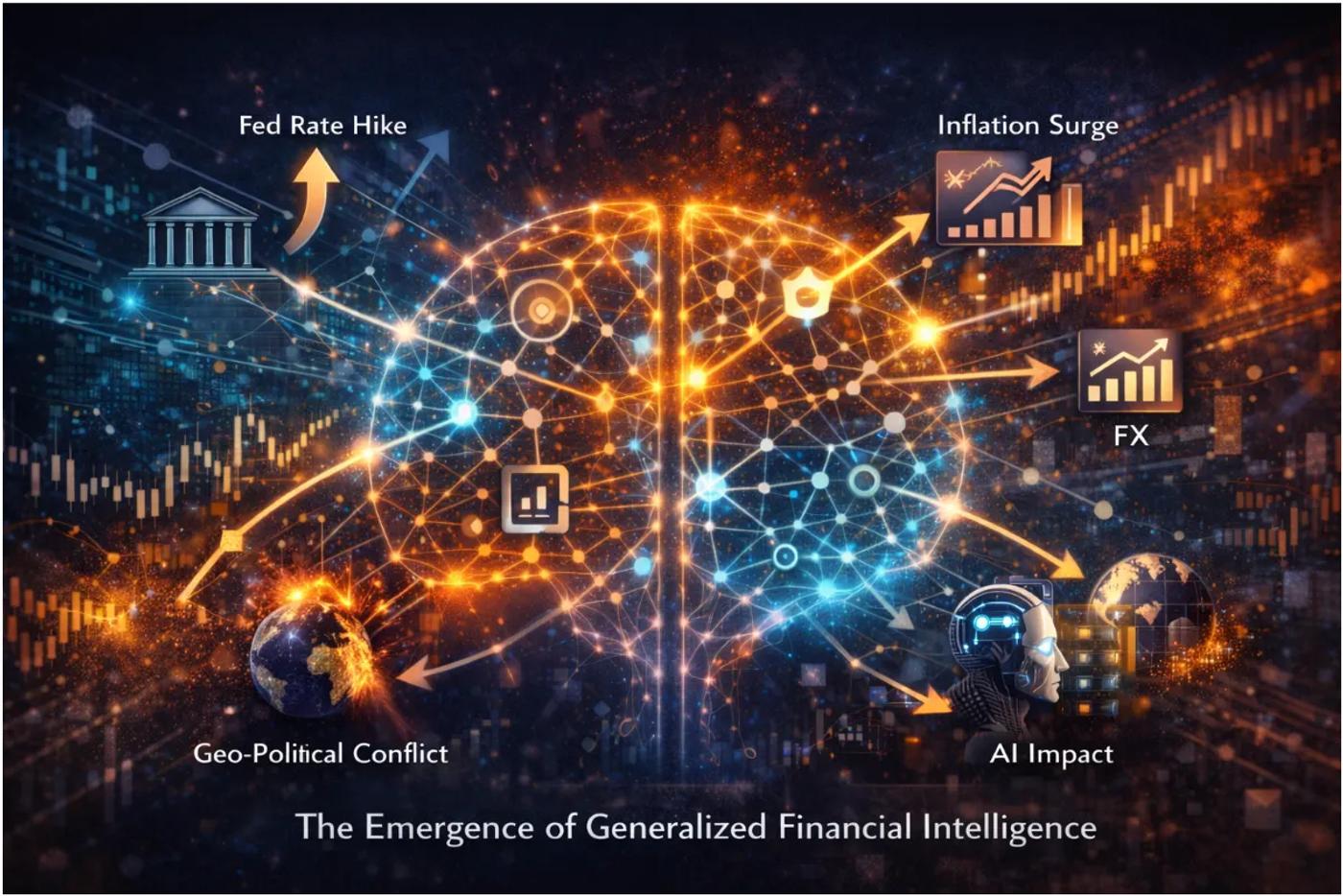
Analysts may need to simulate the cross-asset impact of geopolitical events, evaluate structured products, trace how macroeconomic signals propagate through portfolios, or assess changing risk constraints — tasks that require contextual reasoning rather than simple prediction.
Static and stateless pipelines struggle with this diversity because each new question requires a predefined workflow. Recent advances in generative and agentic AI are changing this paradigm by enabling systems to construct computation dynamically — generating analysis, invoking models, and orchestrating reasoning on demand [4][5].
Financial markets are inherently causal and contextual systems, and meaningful financial intelligence requires combining inductive learning from data with deductive reasoning about economic structure and constraints [1]. At HyperNorm AI, modern AI architectures are being designed to bring these capabilities together.
2. The Long Tail of Financial Intelligence
Most financial decision problems lie in the long tail of complexity.
Portfolios often contain unusual instruments and highly customized client constraints, while market events interact across assets in nonlinear ways that static models struggle to capture. A single portfolio may need to balance risk tolerances, liquidity requirements, tax considerations, and allocation mandates while responding to macroeconomic signals across asset classes.
Because the space of financial questions is so large, pre-building workflows for every scenario becomes impractical. Instead, financial intelligence systems must dynamically construct analytical workflows, assembling the computation required for each specific context. Recent progress on agentic and multi-agent AI systems that coordinate analytical tasks dynamically rather than relying on predefined pipelines [4][6].
3. From Software to Systems that Write Software
Recent advances in large language models have introduced a new paradigm: AI systems that generate software as part of their reasoning process.
Models such as Claude and GPT can produce executable code, enabling agents to solve complex analytical tasks dynamically through vibe coding, rather than relying on developers to predefine every computational step.
When a user query or input arrives, an AI agent can generate code, execute it, evaluate the results, and iteratively refine the analysis. The system effectively follows a reasoning loop:
User Query → Agent → Generate Code → Execute → Evaluate → Iterate.
Instead of relying on fixed pipelines, such systems dynamically construct the computation required for each task — a paradigm shift in building AI systems. [5][11].
3.1 Ephemeral Code
A key concept in this paradigm is ephemeral code, it is the code generated dynamically to solve a specific analytical problem, executed immediately, and discarded once the computation is complete.
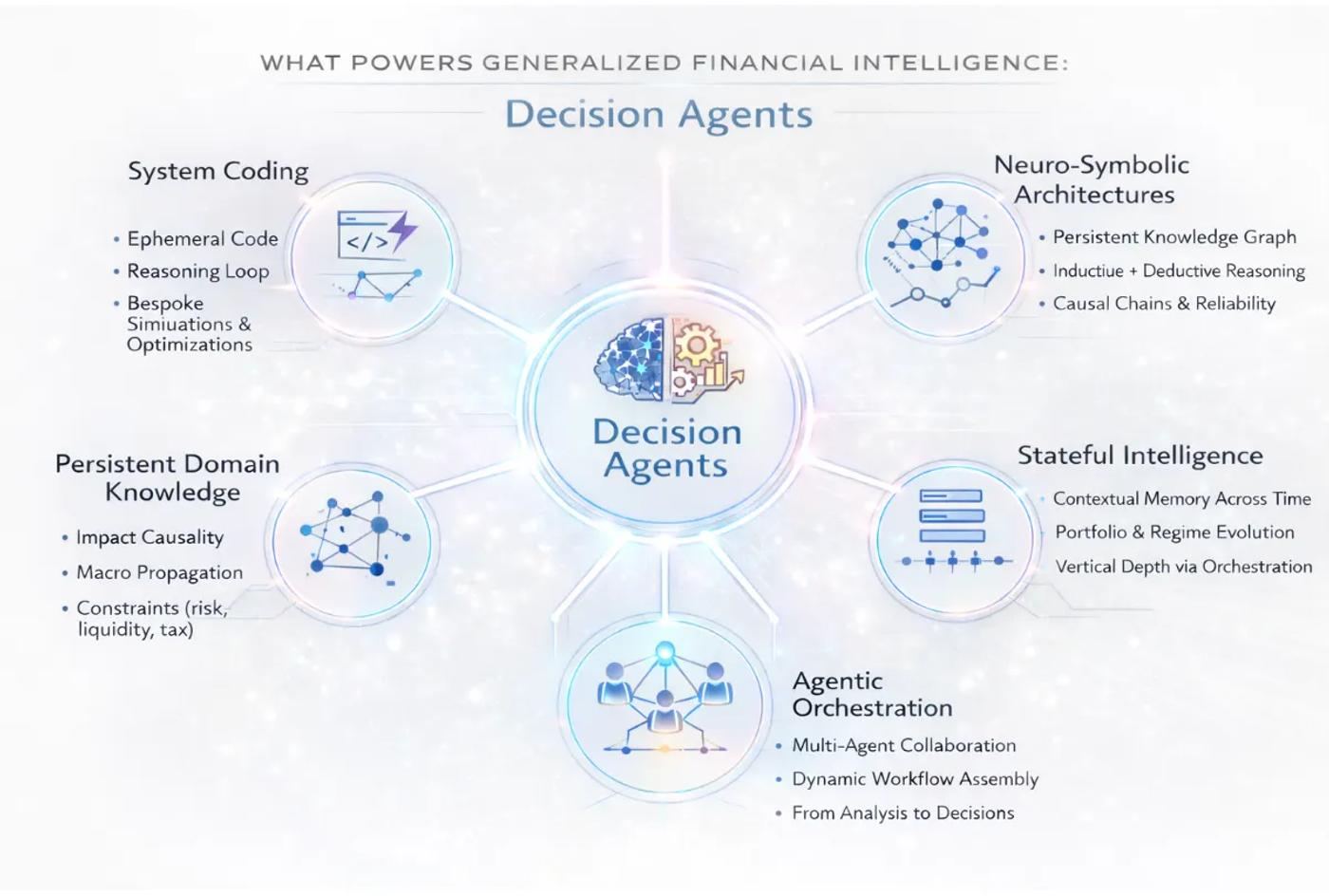
In financial intelligence systems, this enables dynamic generation of portfolio optimizations, macroeconomic shock simulations, cross-asset analyses, and stress tests, creating bespoke computation for each problem rather than relying on predefined analytics.
At HyperNorm AI, these ephemeral computations are dynamically executed and are integrated into structured logging pipelines, ensuring each generated step is recorded for auditability and easier debugging.
3.2 A Simple Example
Consider a portfolio manager asking: How would a 75-basis-point Federal Reserve rate hike affect my portfolio?
A generalized financial intelligence system could retrieve macroeconomic relationships from a financial knowledge graph, identify how rate changes propagate across bonds, equities, and FX, and generate simulation code to model the impact. It would then run sensitivity analyses, evaluate results against portfolio constraints such as risk limits and liquidity requirements, and produce a structured explanation with potential adjustments.
Multi-agent architectures are increasingly explored for such workflows, where specialized agents collaborate on data retrieval, modeling, and evaluation [8]. The key point is that the analytical workflow is constructed dynamically rather than predefined.
4. Systems Coding for AI Reasoning
These capabilities fundamentally change the role of developers. In traditional systems, engineers implemented every computational step manually. Modern AI architectures operate at a higher level of abstraction, where developers design systems capable of generating solutions rather than encoding them directly.
This involves defining abstractions for financial concepts, building specialized modules, and designing interfaces through which reasoning occurs. The workflow becomes: Describe system → Define abstractions → Decompose modules → Align interfaces → Generate code → Execute → Evaluate → Refine.
Rather than rigid pipelines, engineers design architectures that enable reasoning. Agentic AI frameworks increasingly emphasizes modular systems and coordinated agents over monolithic models [4][5]. At HyperNorm AI, we build financial intelligence systems around this principle, using modular agent-driven architectures that dynamically orchestrate models and analytical tools.
5. Persistent Knowledge: The Memory Layer
While large language models provide flexible reasoning, financial intelligence also requires structured domain grounding. Neuro-symbolic architectures combine neural models for pattern recognition with symbolic systems that encode structured knowledge, improving reasoning reliability [2][7].
In these systems, knowledge acts as the persistent memory layer. Knowledge graphs capture relationships between assets, macroeconomic indicators, events, and market regimes, enabling AI systems to reason about causal chains in financial markets [3].
6. Stateful AI: Depth of Intelligence
Another essential component of financial intelligence is statefulness. Many AI systems operate statelessly, treating each query independently. Financial decision-making, however, unfolds over time as portfolio states evolve, signals accumulate, and market regimes shift.
Stateful AI systems maintain contextual awareness across interactions and orchestrate multiple specialized models for different analytical tasks. This creates vertical depth of intelligence, where capability emerges from the interaction of specialized components rather than a single model. The stateful memory, planning, and coordination across agents are key to building more adaptive systems [6][7].
7. The Dawn of Financial Decision Intelligence
When these architectural elements come together, a new class of AI systems emerges. Dynamic code generation enables analytical workflows to be constructed on demand, neuro-symbolic architectures inject domain knowledge into reasoning, and stateful intelligence preserves context over time. Agentic orchestration then coordinates multiple specialized models to solve complex financial problems [4][5][6][8].
Together, these capabilities move financial AI beyond simple prediction. Instead of merely forecasting markets, such systems can interpret events, reason across portfolios and constraints, and support real financial decisions. As Ravikant has noted, intelligence itself may increasingly become commoditized [13]. The real advantage will lie in systems that orchestrate intelligence into action.
In this sense, Generalized Financial Intelligence becomes the foundation for Financial Decision Intelligence — systems that combine dynamic computation, structured knowledge, and contextual reasoning to support decisions at scale. At HyperNorm AI, this vision guides how we design financial intelligence systems for complex portfolio analysis and decision-making.
Bibliography
[1] HyperNorm AI — Reasoning with Markets: Orchestrating Inductive and Deductive Reasoning https://medium.com/@hypernorm.ai/reasoning-with-markets-orchestrating-inductive-and-deductive-reasoning-e3d21370d0a0
[2] HyperNorm AI — Unlocking the Potential of LLMs: The Power of Neuro-Symbolic Systems in Finance https://medium.com/@hypernorm.ai/unlocking-the-potential-of-llms-the-power-of-neuro-symbolic-systems-in-finance-1dee43845d56
[3] HyperNorm AI — Impact Causality: The Next Frontier in AI-Driven Asset Management https://medium.com/@hypernorm.ai/impact-causality-the-next-frontier-in-ai-driven-asset-management-d39b77bd310c
[4] Agentic AI Frameworks: Architectures, Protocols, and Design Challenges https://arxiv.org/abs/2508.10146
[5] LLM-Powered AI Agent Systems and Their Applications in Industry https://arxiv.org/abs/2505.16120
[6] Beyond Self-Talk: Communication-Centric Survey of LLM Multi-Agent Systems https://arxiv.org/abs/2502.14321
[7] Memory in the Age of AI Agents https://arxiv.org/abs/2512.13564
[8] AlphaAgents: Large Language Model Based Multi-Agents for Equity Research and Portfolio Management https://arxiv.org/abs/2508.11152
[9] Agentic AI Systems Applied to Tasks in Financial Services https://arxiv.org/abs/2502.05439
[10] Are Generative AI Agents Effective Personalized Financial Advisors? https://arxiv.org/abs/2504.05862
[11] Andrej Karpathy — AI systems generating code and automating workflows https://news.aibase.com/news/22074
[12] Naval Ravikant — Intelligence becoming a commodity https://nav.al/ai
More from the blog

Impact Causality: why AI-driven asset management must go beyond correlation and use causal AI to judge the risk and reward of investment decisions.

Discover how higher-order agentic systems combine contextual memory, scenario simulation, and adaptive reasoning to help wealth managers interpret market shifts, compare possible futures, and inform investment decisions.
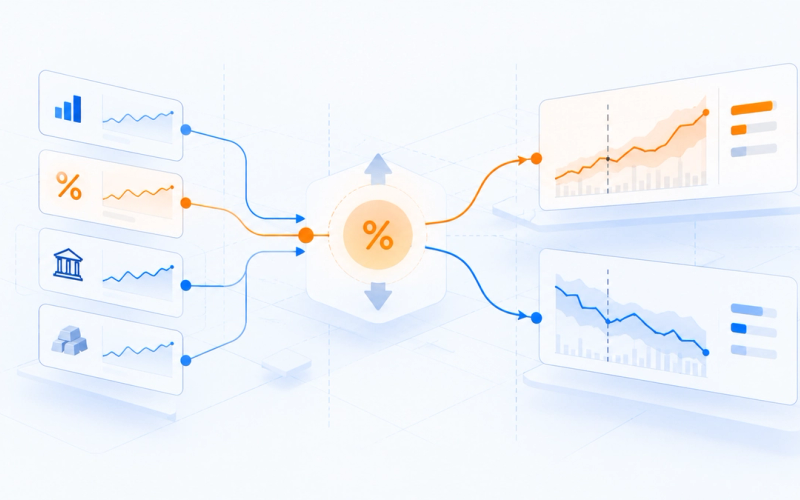
Explore how inductive reasoning, deductive rules, and reinforcement learning work together in financial AI, helping fund managers interpret market signals, assess risks and make decisions while retaining human oversight.