Reasoning with Markets: Orchestrating Inductive and Deductive Reasoning
Explore how inductive reasoning, deductive rules, and reinforcement learning work together in financial AI, helping fund managers interpret market signals, assess risks and make decisions while retaining human oversight.


Introduction: The Flip in Reasoning Systems
Financial reasoning, much like human cognition, operates on two complementary engines: the fast and intuitive versus the slow and deliberate, or in another framing, synthesis versus analysis. In more formal terms, these are inductive and deductive reasoning.
For decades, computer science leaned heavily on deductive systems — logic, proofs, rule-based programming — with inductive learning added as an afterthought. But modern AI has flipped this hierarchy. Today’s most powerful systems are fundamentally inductive (deep learning, pattern recognition, statistical inference), yet to be truly intelligent and useful, they must integrate deductive scaffolding and an orchestration layer that coordinates both [1][3].
Financial asset management mirrors this shift. What was once a model-driven, rule-heavy discipline now increasingly relies on adaptive, inductive intelligence — but it cannot thrive without the rigor and discipline of deduction.
Deductive Reasoning: The Structural Backbone
Deductive reasoning is about starting from principles and deriving consequences. In finance, this manifests as:
- No-arbitrage conditions: prices should align to prevent risk-free profits.
- Accounting identities: assets must balance liabilities.
- Constraints and rules: regulatory, risk limits, capital requirements.
These structures are non-negotiable. They define the playing field.
In AI terms, deductive modules are symbolic systems, theorem provers, or rule-based engines — guardrails that keep decision-making grounded. Work on neuro-symbolic reasoning highlights the importance of such deductive scaffolding, ensuring AI remains interpretable and aligned with constraints [2][3][11].
Inductive Reasoning: Learning from Patterns
Inductive reasoning is probabilistic, adaptive, and empirical. In markets, it means learning from historical data, observing correlations, or building predictive signals. Neural networks, ensemble methods, and deep statistical learning excel here.
Induction is powerful, but it is also fallible. It can overfit noise, underweight structural constraints, or hallucinate patterns that don’t exist. Just as traders chase illusory correlations, AI systems misread signals when left unconstrained.
Architectures like transformers, graph neural networks (GNNs), and diffusion models have pushed inductive reasoning to unprecedented levels, enabling machines to generalize patterns across massive, unstructured data — spanning language, markets, and multimodal signals [2][3].
Bayesian Uncertainty: Why Induction Alone Isn’t Enough
Fundamentally, inductive systems learn from data, but they rarely learn at the optimal level. Even the most sophisticated pattern-recognition models carry irreducible Bayesian errors — the gaps between updated probabilities and reality [9].
In practice, this means they can misestimate uncertainty, overweight recent patterns, or fail to incorporate structural constraints.
This is why purely inductive systems, whether in AI or investing, are fragile. Left on their own, they might adapt endlessly but never converge toward stability.
Here is where deductive modules become indispensable. Deduction acts as a patching mechanism for inductive errors:
- Guardrails that prevent overfitting noise.
- Structural rules that remain valid even when inductive updates misfire.
- Anchors that constrain entropy from spiraling into chaos.
Together, induction provides flexibility, while deduction ensures consistency. And orchestration balances the two, allowing markets (and machines) to navigate uncertainty more reliably.
Reinforcement Learning: The Market’s Native Language
Many financial problems — predicting asset prices, measuring causal impacts, assessing risk — are not fundamentally differentiable. Random, entropic events (policy shocks, geopolitical tensions, sudden liquidity crunches) can sway outcomes in ways no gradient can cleanly capture.
As explored in prior work on impact causality, such shocks highlight the limitations of purely differentiable models, which assume smooth, continuous mappings where none exist [7].
Here, reinforcement learning (RL) offers a more natural paradigm. Instead of relying on differentiability, RL learns by linking tangible future rewards to relevant sequences of events. In finance:
- A strategy may take losses today but secure long-term stability.
- A rebalancing action can improve portfolio resilience only months later.
- The true “reward” of risk management is often visible only under stress.
RL thrives under such conditions because it focuses on trial, reward, and adjustment. It doesn’t need a perfect model of the world; it only needs a signal of what worked and what didn’t. For markets, this is closer to reality than any static prediction framework.
Neuro-symbolic reinforcement learning research in trading further underscores this synergy between trial-based learning and structured reasoning [4], while advances in causality-based explainable AI reinforce RL’s fit in non-differentiable, shock-driven domains [5].
Orchestration: Where the Magic Happens
Induction adapts, deduction constrains, reinforcement learning explores — but no single mode can “run the show.”
The future of financial AI hinges on orchestration, where multiple reasoning engines collaborate:
- Deduction enforces market structure and feasibility.
- Induction extracts predictive patterns and hypotheses.
- Reinforcement learning guides strategies toward long-term, reward-aligned behavior.
This orchestration mirrors a functioning investment committee: one member is cautious, another exploratory, and a third outcome-driven. Together, they create a system greater than the sum of its parts.
Crucially, this dynamic interaction is deeply aligned with the principles of neuro-symbolic AI systems — bringing together intuitive neural learning (System 1) with structured, symbolic logic (System 2) to enhance decision-making in complex environments [1][2].
In practice, as highlighted in applied financial AI work, a neuro-symbolic architecture enables AI to learn from data at scale while reasoning within constraints, making it indispensable for trustworthy orchestration [6].
Toward an Ecosystem of Interconnected AI Agents
In reality, no single model can capture the vast complexity of markets. What emerges instead is an ecosystem of specialized AI agents, each assuming a familiar role:
- One behaves like a qualitative analyst, extracting narratives from news and earnings calls.
- Another acts as a risk manager, quantifying exposure and stress scenarios.
- Yet another mirrors a regulator, ensuring compliance and systemic checks.
These agents don’t work in isolation — they exchange signals, validate one another’s outputs, and resolve conflicts where inductive predictions, deductive rules, or reinforcement cues diverge.
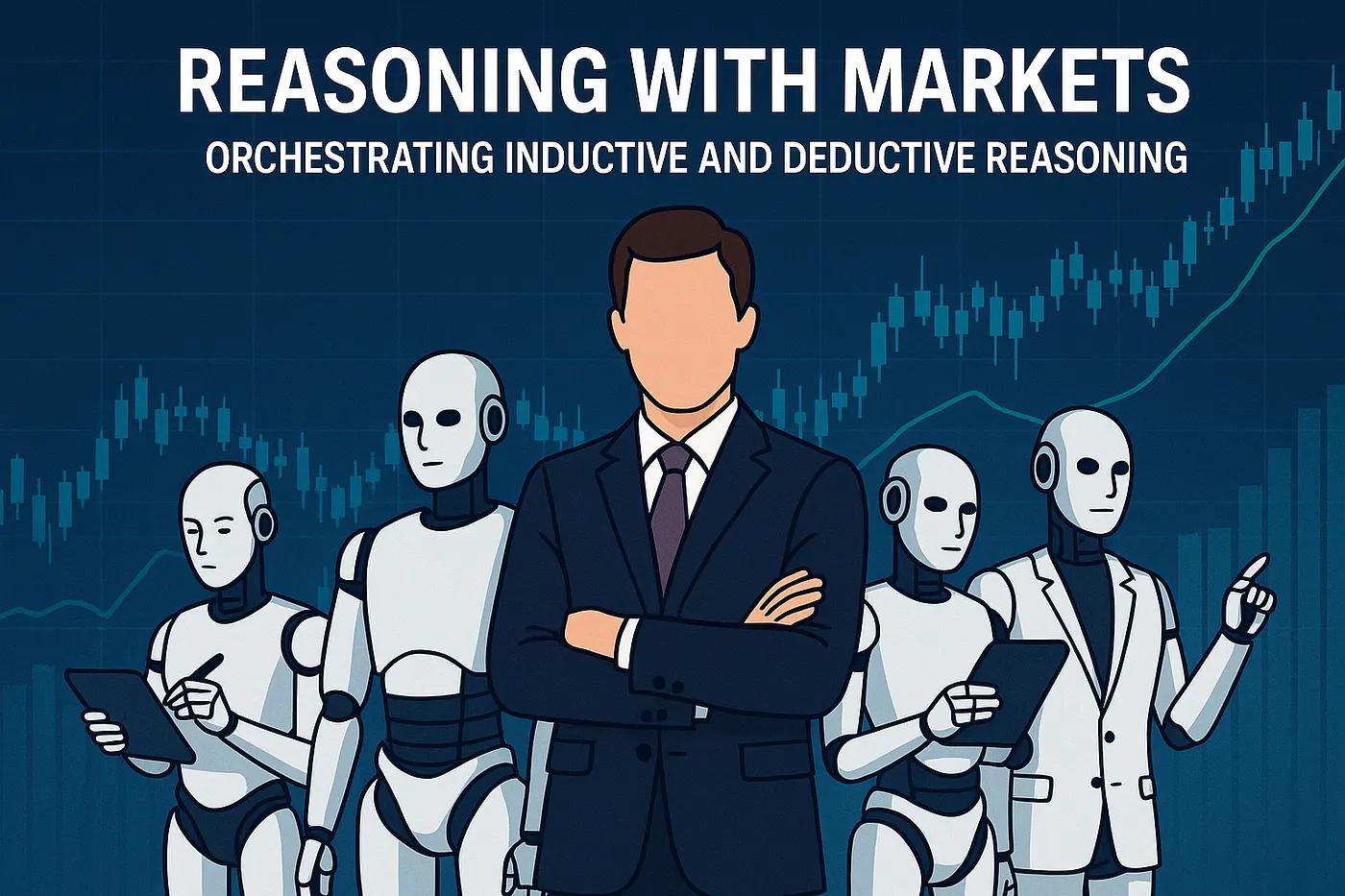
Crucially, they operate in service of the advisor or fund manager at the center, who remains in the loop to weigh context, intuition, and client-specific objectives [10].
The orchestration between these agents ensures that market reasoning — inductive, deductive, and reinforcement-based — is not just automated but augmented, amplifying human decision-making while keeping accountability firmly with the fund manager.
Conclusion: Orchestrated Reasoning for the Future of Finance
The future of financial AI will not be purely inductive, deductive, or reinforcement-driven. Instead, it will be a synthesis — where inductive systems learn from data, deductive modules provide corrective rigor, reinforcement learning captures outcomes under uncertainty, and interconnected AI agents orchestrate the process.
Just as markets themselves are a dance of competing forces, the next generation of AI in finance will be an orchestrated ensemble of reasoning systems, designed not to replace the fund manager but to empower them with clarity, foresight, and resilience.
The No Free Lunch Theorem makes this inevitability clear: no single paradigm suffices, only a coordinated ensemble can deliver robustness [8].
References
- van Bekkum, M., de Boer, M., van Harmelen, F., Meyer-Vitali, A., & Teije, A. T. (2021). Modular design patterns for hybrid learning and reasoning systems: a taxonomy, patterns and use cases. Applied Intelligence, 51(9), 6528–6546.
- Liang, B., Wang, Y., & Tong, C. (2025). AI Reasoning in Deep Learning Era: From Symbolic AI to Neural–Symbolic AI. Mathematics, 13(11), 1707.
- Cheng, K., Yang, J., Jiang, H., Wang, Z., Huang, B., Li, R., … & Sun, Y. (2024). Inductive or deductive? rethinking the fundamental reasoning abilities of LLMs. arXiv preprint arXiv:2408.00114.
- Harini, S. I., Gautam Shroff, Ashwin Srinivasan, Prayushi Faldu, and Lovekesh Vig. Neuro-symbolic meta reinforcement learning for trading. arXiv preprint arXiv:2302.08996 (2023).
- Carloni, G., Berti, A., & Colantonio, S. (2025). The role of causality in explainable artificial intelligence. Wiley Interdisciplinary Reviews: Data Mining and Knowledge Discovery, 15(2), e70015.
- HyperNorm AI. Unlocking the Potential of LLMs: The Power of Neuro-Symbolic Systems in Finance. Medium. https://medium.com/@hypernorm.ai/unlocking-the-potential-of-llms-the-power-of-neuro-symbolic-systems-in-finance-1dee43845d56
- HyperNorm AI. Impact Causality: The Next Frontier in AI-Driven Asset Management. Medium. https://medium.com/@hypernorm.ai/impact-causality-the-next-frontier-in-ai-driven-asset-management-d39b77bd310c
- Adam, S. P., Alexandropoulos, S. A. N., Pardalos, P. M., & Vrahatis, M. N. (2019). No free lunch theorem: A review. Approximation and optimization: Algorithms, complexity and applications, 57–82.
- Smith, F. B., Kossen, J., Trollope, E., van der Wilk, M., Foster, A., & Rainforth, T. (2024). Rethinking aleatoric and epistemic uncertainty. arXiv preprint arXiv:2412.20892.
- Guo, T., Chen, X., Wang, Y., Chang, R., Pei, S., Chawla, N. V., … & Zhang, X. (2024). Large language model based multi-agents: A survey of progress and challenges. arXiv preprint arXiv:2402.01680.
- Sheth, A., Roy, K., & Gaur, M. (2023). Neurosymbolic artificial intelligence (why, what, and how). IEEE Intelligent Systems, 38(3), 56–62.
More from the blog

Impact Causality: why AI-driven asset management must go beyond correlation and use causal AI to judge the risk and reward of investment decisions.


Discover how higher-order agentic systems combine contextual memory, scenario simulation, and adaptive reasoning to help wealth managers interpret market shifts, compare possible futures, and inform investment decisions.

Explore how dynamic code, neuro-symbolic systems, and stateful AI combine to create financial intelligence that adapts to complex portfolio questions, preserves context, and supports informed decisions as markets evolve.