Unlocking the Potential of LLMs: The Power of Neuro-symbolic Systems in Finance
Neuro-symbolic systems bring together the pattern recognition of neural models and the structured reasoning of symbolic AI. This article explores how that combination addresses limitations of LLMs in finance.


In Daniel Kahneman’s Thinking, Fast and Slow, the human mind is described as operating through two distinct systems:
- System 1: Fast, automatic, intuitive, and effortless.
- System 2: Slow, deliberate, analytical, and effortful.
These systems reflect different cognitive processes, with System 1 being instinctive and System 2 being analytical. In the context of artificial intelligence (AI), these systems can be mapped to two types of computational models:
- System 1 aligns with neural networks, which process vast amounts of data quickly and make intuitive decisions.
- System 2 aligns with symbolic AI, which relies on formal rules, logic, and structured reasoning for decision-making.
In the domain of fintech and finance, the need to combine System 1 and System 2 to make more informed, reasoned, and rapid decisions has never been more critical. Neurosymbolic systems, which combine these two approaches, hold significant promise for overcoming some of the limitations faced by Large Language Models (LLMs), enhancing their utility in finance.
System 1 as a Neural System: Speed and Pattern Recognition in Finance
Neural systems, such as deep learning networks, process data quickly and efficiently, enabling System 1-like behavior. In finance, these systems can analyze historical data and recognize patterns to make fast predictions or detect anomalies. Some of the areas where neural systems excel in finance include:
- Predictive Analytics: Neural networks can rapidly analyze vast datasets to predict asset prices, market trends, and consumer behaviors (Bengio et al., 2013). For instance, LLMs such as GPT-4 are frequently used for generating text-based market predictions or assisting in sentiment analysis of financial news.
- Risk Assessment: Machine learning models can detect financial fraud or compliance issues by analyzing patterns in transactional data (Johora et al., 2024). Neural networks help institutions spot irregularities that would be difficult to identify manually.
- Quant Trading: In algo trading or quant trading, neural networks process market data in real-time to execute trades based on immediate price movements (Bi et al., 2024). This speed and pattern recognition are crucial for success in rapidly evolving financial markets.
Despite these strengths, neural systems face challenges that hinder their performance in more complex financial tasks.
System 2 as a Symbolic System: Structured Decision-Making in Finance
On the other hand, System 2 relies on more structured and logical reasoning, which is vital for complex financial decisions that go beyond simple pattern recognition. Symbolic systems — which use formal rules, logic, and structured knowledge (i.e. knowledge base) — are crucial in areas where reasoning and consistency matter most. In finance, symbolic systems play an essential role in:
- Portfolio Optimization: Symbolic AI is well-suited for formalizing the process of portfolio optimization, where decisions are based on abstract financial concepts like risk, return, and diversification (Markowitz, 1952). These models take into account economic factors, market behavior, and asset relationships.
- Asset Management Decision-Making: A symbolic AI system could use a rule-driven framework to suggest new investment opportunities and assess risk implications. For example, if an asset’s risk exceeds a set threshold, the system might recommend reallocating investments or diversifying into safer assets. The fund manager then reviews these suggestions, considering market conditions and investor goals, before making the final decision (Markowitz, 1952).
- Regulatory Compliance: Financial institutions rely on rule-based engines to ensure adherence to regulatory standards, like KYC (Know Your Customer) and AML (Anti-Money Laundering) (Adeniran et al. 2024). Symbolic AI models can formalize compliance rules and help systems stay up to date with changing regulations.
While symbolic systems offer powerful reasoning capabilities, they often lack the flexibility and adaptability of neural systems, which are crucial for handling large, unstructured datasets like financial market data.
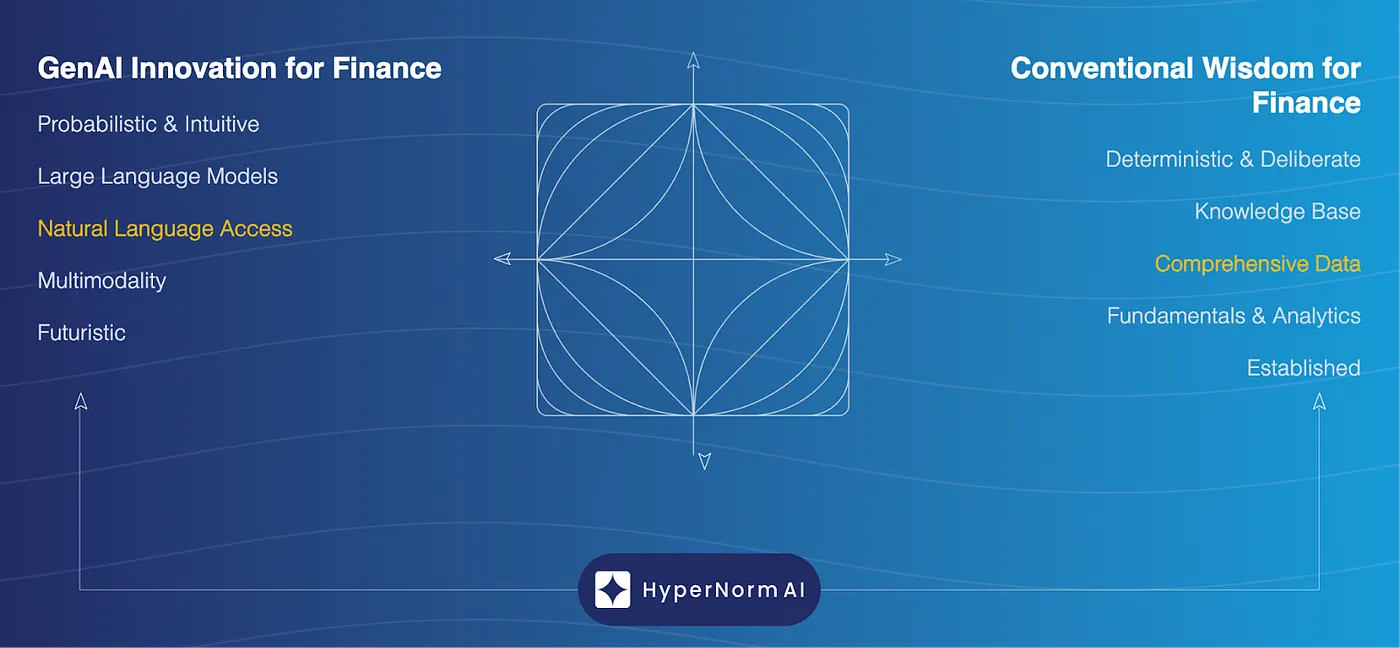
At HyperNorm AI, we have built the platform which powers the product offerings in the application layer. At the platform layer we integrate best of both the systems (Figure 1) for empowering fund managers with suites of financial services. Just an example, transformer neural architecture is extended to leverage symbolic knowledge as well for asset price prediction, and we have achieved directional accuracy of 74%+ for the prediction of smooth price over 1day, 1week, 1month and 1quarter.
Challenges Faced by Neural Systems (LLMs) in Finance
Despite their remarkable successes, neural networks, particularly Large Language Models (LLMs), face several limitations in the finance domain, including:
- Hallucination: LLMs occasionally generate outputs that are inaccurate or fabricated, which is especially problematic in finance where incorrect predictions or advice can lead to significant financial losses (Bender et al., 2021).
- Reasoning Ability: While LLMs excel in pattern recognition, they struggle with logical reasoning and complex, multi-step processes. In finance, decisions like portfolio construction or risk assessment require more than just pattern matching — they demand systematic reasoning and long-term planning (Son et al., 2023).
- Higher Order Problems and Workflows: LLMs tend to perform poorly on complex financial workflows, such as optimizing a portfolio with multiple constraints or making strategic decisions that require consideration of long-term consequences (Wang, 2024).
- Data Bias: LLMs are susceptible to biases inherent in historical data. If the data reflects past market biases, the models may perpetuate them, leading to skewed predictions or recommendations (Pavón et al., 2022).
- Limited Context Length: LLMs are constrained by their context window, meaning they can only process a fixed amount of data at once. In financial contexts where decision-making spans across long time periods (e.g., multi-year investment strategies), this limitation can be detrimental (Brown et al., 2020).
While few-shot learning and fine-tuning can mitigate some of these issues, the need for a more integrated approach that combines System 1’s fast decision-making with System 2’s reasoning abilities is clear.
Fusion of Neural and Symbolic Systems: Addressing Challenges in Financial AI
To overcome the limitations of purely neural systems, the combination of System 1 (neural networks) and System 2 (symbolic reasoning) is an emerging solution. Neurosymbolic systems aim to integrate the strengths of both approaches, offering a hybrid that enhances LLMs for more reliable, explainable, and efficient financial decision-making. Here are some ways this fusion can be achieved:
1. Knowledge Infusion in Models
- Architectural Changes: Integrating domain-specific financial knowledge directly into neural models through neural-symbolic integration helps models reason about complex financial data, such as market movements, regulations, and economic indicators (Sheth et al., 2023).
- Infusion During Fine-Tuning: Fine-tuning LLMs with structured financial knowledge — such as risk management models or economic theories — improves their reasoning abilities, making them better suited for high-stakes decision-making (Faldu et al., 2021).
2. Retrieval-Augmented Generation (RAG)
- Leveraging Context Length: In finance, tasks like investment decision-making or risk analysis require access to large amounts of historical data. RAG architectures augment neural networks by enabling them to retrieve relevant external knowledge (e.g., from knowledge graphs or databases), ensuring better decision-making with extended context (Peng et al., 2024).
- Knowledge Graphs: Integrating structured financial knowledge graphs as part of the input context can enhance the ability of LLMs to reason logically about relationships between assets, economic factors, and market trends, ensuring more accurate predictions and insights (Cheng et al., 2022).
3. Agentic Orchestration (Virtual Agents)
- Decomposition and Workflow Management: In complex financial workflows, virtual agents can break down tasks (such as multi-step investment strategies or complex thematic financial research) into smaller, manageable steps. Symbolic reasoning ensures each step follows logical rules, while neural networks enable rapid processing of data at each stage (Rasal et al., 2024).
- Multi-Agent Systems: These systems allow various agents (both symbolic and neural) to coordinate across financial tasks, ensuring logical consistency while leveraging neural networks for pattern recognition and quick decision-making.
4. Knowledge-Aware Peripheral Systems
- Maker-Checker Systems: In finance, maker-checker systems — where one system generates decisions and another verifies them — can integrate symbolic reasoning for validation. This ensures that outputs are logically consistent and compliant with financial regulations (Quelle et al., 2024, Shankar et al., 2024, Giarelis et al., 2024)
- Synthetic Data Generation: To mitigate issues like data bias or scarcity, symbolic systems can generate synthetic data leveraging symbolic knowledge captured in knowledge graphs that simulate real-world financial conditions, helping train more robust AI models (Namperumal et al., 2022, Pan et al. 2024).
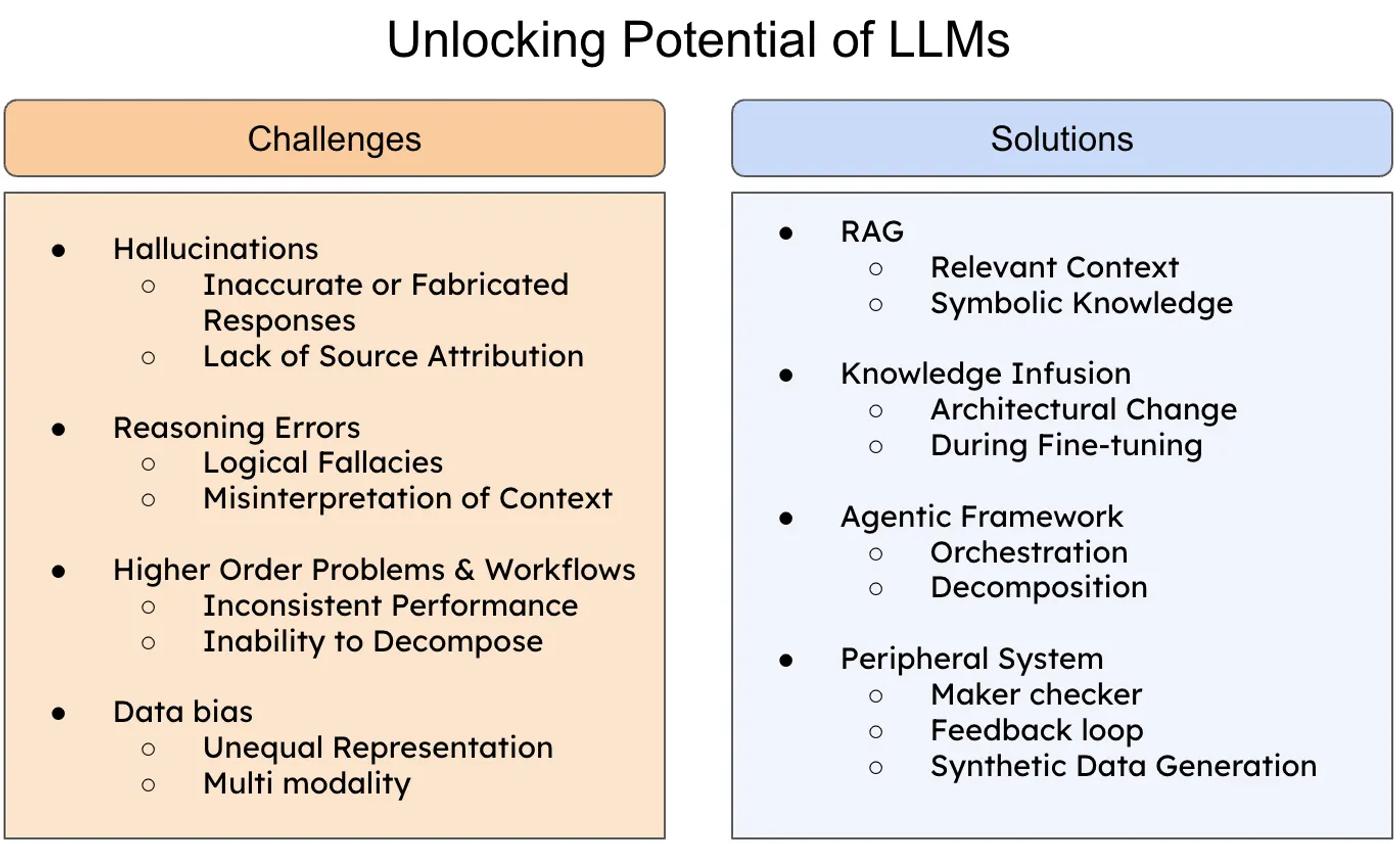
At HyperNorm AI, we unlock the potential of LLMs to help make better financial asset management decisions using the approaches mentioned above in the figure 2. Hyper Agent is one of the products leveraging above solutions to support AI agents for thematic research for financial use cases.
The Future of Neurosymbolic AI in Finance
The future of AI in finance will likely revolve around the integration of neural systems (System 1) and symbolic reasoning (System 2) to create neurosymbolic AI. This approach offers several significant advantages:
- Enhanced Decision-Making: Combining the intuitive decision-making capabilities of neural networks with the structured, logical reasoning of symbolic systems leads to more reliable and explainable financial decisions, such as portfolio management and risk assessment.
- Improved Interpretability: The transparency of symbolic reasoning improves the interpretability of AI models, allowing financial professionals to understand the reasoning behind decisions, fostering trust in automated systems.
- Generalized AI for Finance: As we move toward artificial general intelligence (AGI), neurosymbolic systems could be key to building AGI capable of managing
References
- Wang, L., Ma, C., Feng, X., Zhang, Z., Yang, H., Zhang, J., … & Wen, J. (2024). A survey on large language model based autonomous agents. Frontiers of Computer Science, 18(6), 186345.
- Bender, E. M., Gebru, T., McMillan-Major, A., & Shmitchell, S. (2021, March). On the dangers of stochastic parrots: Can language models be too big?🦜. In Proceedings of the 2021 ACM conference on fairness, accountability, and transparency (pp. 610–623).
- LeCun, Y., Bengio, Y., & Hinton, G. (2015). Deep learning. nature, 521(7553), 436–444.
- Brown, T., Mann, B., Ryder, N., Subbiah, M., Kaplan, J. D., Dhariwal, P., … & Amodei, D. (2020). Language models are few-shot learners. Advances in neural information processing systems, 33, 1877–1901.
- Quelle, D., & Bovet, A. (2024). The perils and promises of fact-checking with large language models. Frontiers in Artificial Intelligence, 7, 1341697.
- Shankar, S., Zamfirescu-Pereira, J. D., Hartmann, B., Parameswaran, A., & Arawjo, I. (2024, October). Who validates the validators? aligning llm-assisted evaluation of llm outputs with human preferences. In Proceedings of the 37th Annual ACM Symposium on User Interface Software and Technology (pp. 1–14).
- Giarelis, N., Mastrokostas, C., & Karacapilidis, N. (2024, May). A Unified LLM-KG Framework to Assist Fact-Checking in Public Deliberation. In Proceedings of the First Workshop on Language-driven Deliberation Technology (DELITE)@ LREC-COLING 2024 (pp. 13–19).
- Bi, S., Bao, W., Xiao, J., Wang, J., & Deng, T. (2024). Application and practice of AI technology in quantitative investment. arXiv preprint arXiv:2404.18184.
- Cheng, D., Yang, F., Xiang, S., & Liu, J. (2022). Financial time series forecasting with multi-modality graph neural network. Pattern Recognition, 121, 108218.
- Pan, S., Luo, L., Wang, Y., Chen, C., Wang, J., & Wu, X. (2024). Unifying large language models and knowledge graphs: A roadmap. IEEE Transactions on Knowledge and Data Engineering.
- Pavón Pérez, Á. (2022, July). Bias in Artificial Intelligence Models in Financial Services. In Proceedings of the 2022 AAAI/ACM Conference on AI, Ethics, and Society (pp. 908–908).
- Peng, B., Zhu, Y., Liu, Y., Bo, X., Shi, H., Hong, C., … & Tang, S. (2024). Graph retrieval-augmented generation: A survey. arXiv preprint arXiv:2408.08921.
- Markowitz, H. M. (1952). Portfolio Selection. The Journal of Finance, 7(1), 77–91. DOI: 10.2307/2975974
- Sheth, A., Roy, K., & Gaur, M. (2023). Neurosymbolic artificial intelligence (why, what, and how). IEEE Intelligent Systems, 38(3), 56–62.
- Namperumal, G., Selvaraj, A., & Surampudi, Y. (2022). Synthetic Data Generation for Credit Scoring Models: Leveraging AI and Machine Learning to Improve Predictive Accuracy and Reduce Bias in Financial Services. Journal of Artificial Intelligence Research, 2(1), 168–204.
- Faldu, K., Sheth, A., Kikani, P., & Akbari, H. (2021). KI-BERT: Infusing knowledge context for better language and domain understanding. arXiv preprint arXiv:2104.08145.
- Rasal, S., & Hauer, E. J. (2024). Navigating Complexity: Orchestrated Problem Solving with Multi-Agent LLMs. arXiv preprint arXiv:2402.16713.
- Son, G., Jung, H., Hahm, M., Na, K., & Jin, S. (2023). Beyond classification: Financial reasoning in state-of-the-art language models. arXiv preprint arXiv:2305.01505.
- Adeniran, I. A., Abhulimen, A. O., Obiki-Osafiele, A. N., Osundare, O. S., Agu, E. E., & Efunniyi, C. P. (2024). Strategic risk management in financial institutions: Ensuring robust regulatory compliance. Finance & Accounting Research Journal, 6(8), 1582–1596.
- Johora, F. T., Hasan, R., Farabi, S. F., Akter, J., & Al Mahmud, M. A. (2024). AI-Powered Fraud Detection in Banking: Safeguarding Financial Transactions. The American Journal of Management and Economics Innovations, 6(06), 8–22.
More from the blog

Impact Causality: why AI-driven asset management must go beyond correlation and use causal AI to judge the risk and reward of investment decisions.


Discover how higher-order agentic systems combine contextual memory, scenario simulation, and adaptive reasoning to help wealth managers interpret market shifts, compare possible futures, and inform investment decisions.

Explore how dynamic code, neuro-symbolic systems, and stateful AI combine to create financial intelligence that adapts to complex portfolio questions, preserves context, and supports informed decisions as markets evolve.